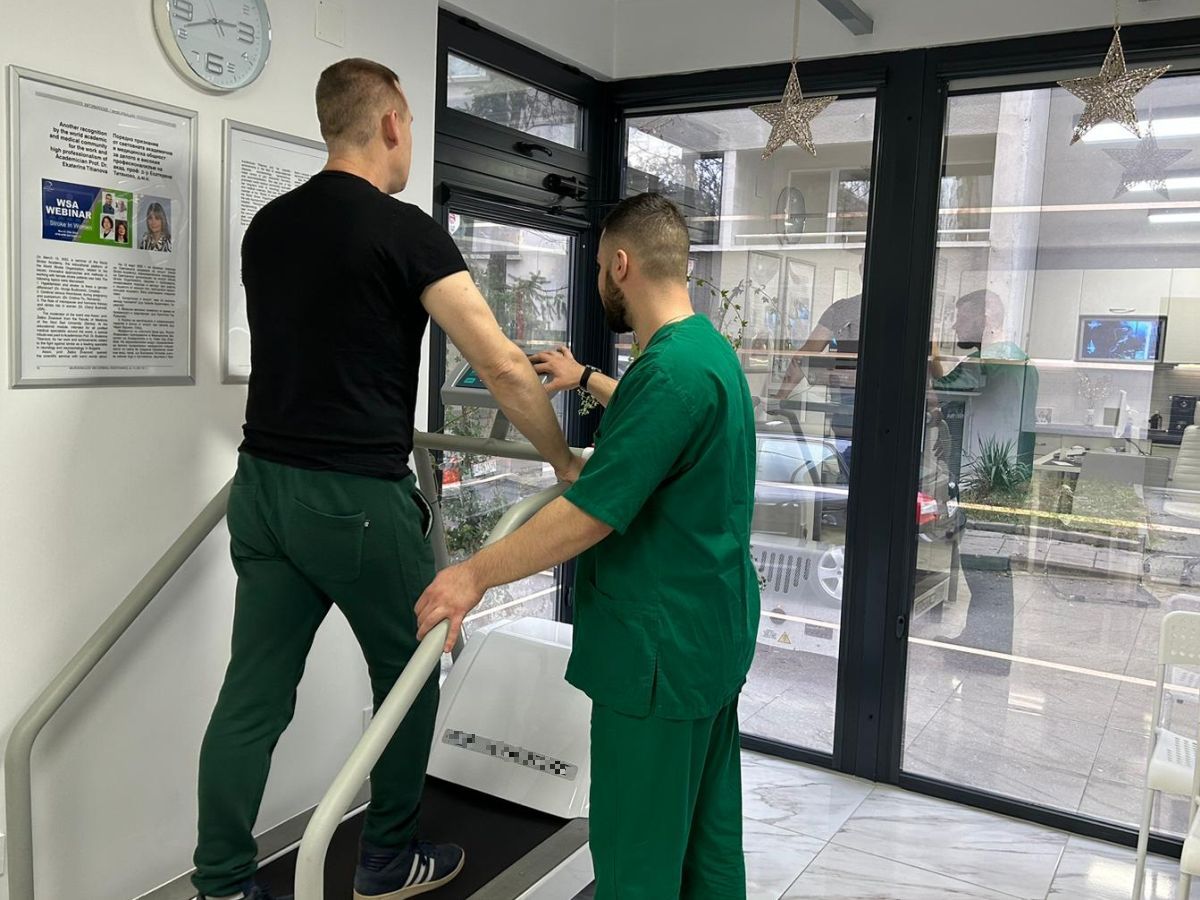
Quality rehabilitation after stroke is key because it helps restore lost functions, accelerates brain plasticity, reduces complications and improves the patient’s quality of life.
New approaches in neurorehabilitation and specialized therapy sessions can accelerate recovery, improve motivation and increase long-term functional independence.
Another proof of this is the scientific work presented by Assistant Petar Petrov conducted in a clinical setting in patients with hemiparesis after stroke.
Assistant Professor Petar Vassilev Petrov from the Medical University – Sofia, Faculty of Public Health, together with a scientific team from the university presented a unique clinical study conducted at the University Multi-profile Hospital for Active Treatment “Tsaritsa Ioanna – ISUL” – Sofia, emphasizing the role of modern neurorehabilitation.
The Eleventh National Congress on Neurosonology and Cerebral Hemodynamics once again proved its prestige as one of the most significant scientific forums in our country, bringing together leading specialists in the field of neurology, ultrasound diagnostics of the nervous system and neurorehabilitation. Among the key highlights of this year’s edition was the presentation of Assistant Professor Petar Petrov, together with the scientific team of Assoc. Prof. Daniela Popova, Ph.D., Assoc. Prof. Todor Dimitrov, MD, and Assoc. Prof. Julieta Gerenova, MD. They shared the results of an innovative clinical study, distinguished by a clearly emphasized focus on advanced methods of neurorehabilitation.
First case of early neurorehabilitation intervention in post-traumatic paresis of the N. Facialis after facelift described in our country.
The scientific paper, presented by Assistant Professor Petrov, examines a clinical case of post-traumatic paresis of the facial nerve, which occurred after aesthetic surgical intervention – a complication with a negative impact on the function of the facial muscles and the psycho-emotional state of the patient. The case is extremely valuable, since for the first time in Bulgaria a systematically documented process of early and multimodal neurorehabilitation is described in a similar clinical picture.
Neurorehabilitation as a basic tool for restoring facial function
The report focused on the role of early, gentle and structured kinesitherapy — a fundamental component of modern neurorehabilitation, which aims to activate neuromuscular mechanisms for regeneration and minimize the risk of long-term functional deficits.
Assistant Petrov emphasized that the effectiveness of the therapy is the result of strict adherence to the principles of neurorehabilitation, including:
early inclusion of therapy, even before the development of compensatory models;
gentle therapeutic progression, tailored to neurophysiological processes;
structured therapeutic plan, built on the basis of objective functional indicators;
continuous monitoring of the patient, supporting the dynamic adaptation of the program.
The patient demonstrated objective improvement by the 12th week, which confirms that the neurorehabilitation approach is not only scientifically justified, but also practically effective, while being safe – with no reported adverse reactions.
Multimodal Neurorehabilitation Protocol – Innovation in Clinical Practice
One of the strongest highlights of the presentation was the development of a personalized neurorehabilitation protocol combining:
neuromuscular retraining based on the principles of motor learning;
specialized facial exercises aimed at symmetry and coordination;
fascial and manual techniques supporting nerve conduction and soft tissue adaptation;
functional tasks restoring natural facial expressions and expression;
This protocol represents an innovative integration of different sciences – anatomy, neurology, physiotherapy and kinesiology – and clearly demonstrates how modern neurorehabilitation can be successfully applied even in rare and complex clinical situations.
Significance for Bulgarian scientific and clinical practice
Assistant Petrov’s presentation was received with great interest, as the report not only adds new knowledge to the national medical literature, but also emphasizes:
the need for early neurorehabilitation intervention;
the importance of an individualized approach;
The case strengthens the position of neurorehabilitation as a leading discipline in the care of patients with peripheral facial paresis and shows the potential of modern, scientifically based methods for functional recovery.
Personal Contribution and Professional Significance
Assistant Professor Petar Petrov’s research is an example of a valuable scientific contribution, combining clinical observation, methodological precision and a deep understanding of the principles of specialized neurorehabilitation.
His participation in the congress proves his actively developing role in the medical community, as well as his aspiration to introduce innovations that can really affect the quality of patient treatment.